Community Interest
Reconnecting Charleston
Downtown Charleston. West Ashley. Mount Pleasant. To locals and visitors alike, these three areas evoke entirely different descriptions, expectations, and emotions. They can feel almost as disparate as they are separated by water. Courtney Olson and her team at Friends of the Lowline are working to change that, building a two-mile linear park through an area historically divided by railroads and highways and…
Downtown Charleston. West Ashley. Mount Pleasant. To locals and visitors alike, these three areas evoke entirely different descriptions, expectations, and emotions. They can feel almost as disparate as they are separated by water. Courtney Olson and her team at Friends of the Lowline are working to change that, building a two-mile linear park through an area historically divided by railroads and highways and, in the process, creating a more connected Charleston for generations to come.
Olson is executive director of Friends of the Lowline, a small nonprofit that has worked quietly behind the scenes to bring that vision to life. “We believed this corridor, split by a railroad and then I-26, could become the thing that reconnects eight neighborhoods instead of dividing them,” she says. “My job is to help carry that vision the rest of the way.”
The mission is straightforward: build, promote, and program the Lowline as a public space that is free and open to everyone. But just as important is making sure the surrounding communities have a voice in what it becomes. No neighborhood wants someone swooping in to dictate what it needs, and listening to those communities is part of Friends of the Lowline’s DNA.
So why here? And why now?
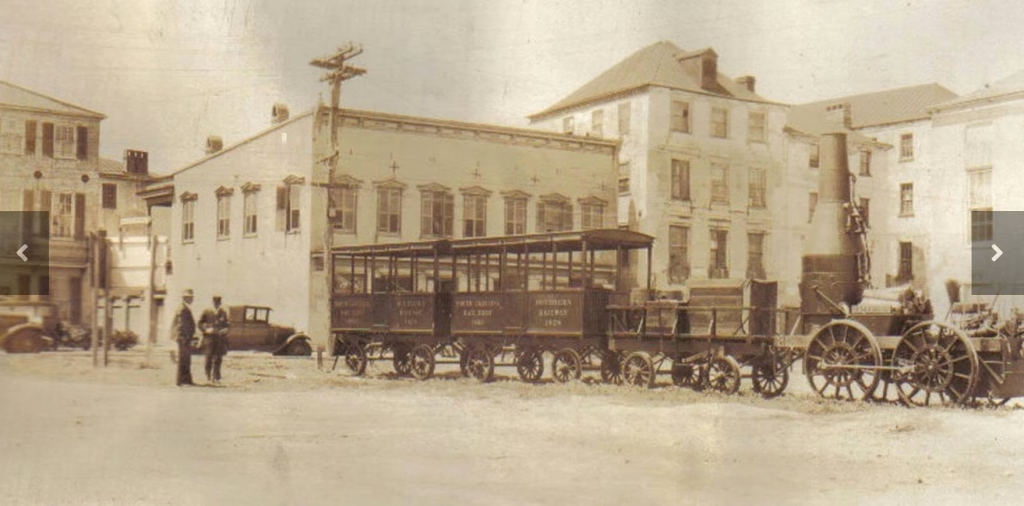
For starters, the corridor is steeped in Charleston history. On Christmas Day in 1830, a locomotive called the Best Friend of Charleston pulled its first passenger train along a six-mile route from Line Street, becoming the first American-built steam locomotive to carry passengers on a public railroad. “A newspaper account from that day described passengers flying ‘on the wings of wind at the speed of fifteen to twenty-five miles per hour, annihilating time and space,’” Olson says. “It was a moment of civic pride and the beginning of a 200-year story that is still being written.” Over time, though, the railroad—and later I-26—divided neighborhoods that had once been vibrant and connected. What remained was a corridor shaped more by infrastructure than community. Friends of the Lowline sees an opportunity to change that.
The vision has already moved beyond the drawing board. Friends of the Lowline and the City of Charleston purchased the land in 2018, with the nonprofit later donating its share back to the City. The City has since pledged more than $15 million toward creating the park, and construction is quietly getting underway.
Now, Olson wants the rest of Charleston to join them. “Friends of the Lowline has been doing this work quietly for a long time,” she says. “This is our invitation for the whole city, and everyone who visits it, to join us in building something that will belong to all of us and grow more beloved over time.”
Want to discover more local? Follow Fig Magazine on Facebook and Instagram for inspiration.